
Table of Contents
For most founders, IT procurement for startups quickly becomes a balancing act. Teams need reliable, fast, secure laptops to do their best work—but early budgets are tight. Investors expect efficiency. Employees expect premium hardware. And IT teams (if you even have one yet) want devices that can scale as you grow.
This tension leaves many startups overspending, under-planning, or stuck with devices that become bottlenecks far too quickly.
What are the common IT mistakes startups make early on?
Many young companies fall into predictable traps:
Buying consumer laptops because they’re cheap—then replacing them within a year
Purchasing devices ad-hoc without any inventory or procurement policy
Underestimating the number of devices needed for new hires
Forgetting about warranty management or security baselines
Buying everything upfront, draining precious runway
These issues slow teams down and waste budget—two things no startup wants.
7 Smarter IT Procurement Tips for Startups

1. Start with a device inventory and growth plan
Before purchasing anything, map out:
Who needs what devices
What roles require higher-spec machines
Expected hiring over the next 6–12 months
A simple spreadsheet is enough in the beginning. This gives you clarity, prevents panic-buying, and helps forecast costs—crucial for smarter IT procurement for startups.
2. Avoid buying upfront — look at leasing or DaaS
Upfront laptop purchases tie up capital that could be used for growth. This is where leasing or Device-as-a-Service (DaaS) becomes a game changer:
No big initial investment
Predictable monthly costs
Hardware refresh without pain
Lower risk and better cashflow
Solutions like Cinch’s laptop subscription model give startups enterprise-grade devices without the financial burden of owning hardware.
3. Choose business-grade laptops (not consumer ones)
Consumer laptops feel cost-effective, but they fail faster, break more often, and lack essential business features:
Better security (TPM chips, biometric login)
Longer warranties
Better build quality
Predictable performance for developers, designers, and GTM teams
Business machines cost slightly more but last much longer—making them the smarter investment.
4. Centralise procurement, even if you’re small
Having one person or partner manage device procurement ensures:
Consistent hardware
Stronger vendor relationships
Lower costs through consolidated purchasing
Faster onboarding
Cinch works as an outsourced procurement partner for many startups, taking laptop setup, security standards, and logistics off the founder’s plate.
5. Standardise devices to reduce support issues
When everyone uses something different, support becomes a nightmare. Standardise device models based on role types:
Standard laptop for business users
High-performance option for engineers/designers
Optional lightweight model for sales teams
This reduces downtime, simplifies troubleshooting, and keeps your IT stack predictable.
6. Plan for onboarding and off boarding from day one
Startups often forget the operational side of laptops.
How fast can you get a laptop to a new hire?
What happens when someone leaves?
Can you wipe devices remotely?
Do you collect everything back on time?
Cinch offers fast shipping, pre-setup devices, and secure off boarding, making this process smooth even with fully remote teams.
7. Track devices and warranties from the start
Losing track of hardware—especially in hybrid or remote teams—is common. Use lightweight tools or spreadsheets to track:
Who has which laptop
Warranty expiry dates
Device health
OS version and security compliance
Cinch provides built-in asset tracking for customers, making IT visibility simple and hands-off.
How Cinch Simplifies IT Procurement for Startups?
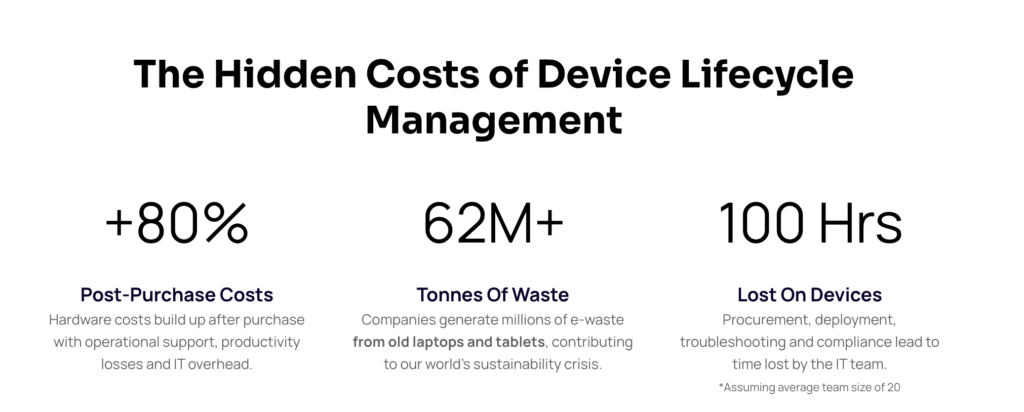
Cinch removes the complexity of IT procurement by giving startups fast, sustainable, and fully managed access to business-grade devices. Instead of buying laptops upfront, startups subscribe to hardware that arrives ready-to-use—pre-configured with enterprise-grade security and zero-touch setup.
With full lifecycle management built in—procurement, setup, support, and off-boarding—Cinch becomes the IT backbone for growing, distributed teams.
Cinch: Smarter, Sustainable, Flexible
Here’s how startups benefit from a model designed to maximise cashflow and operational efficiency:
Zero upfront spend: Predictable monthly OpEx, not heavy CapEx
Devices shipped in days, not months: Fast deployment for teams
Delivered ready-to-use: Pre-configured with built-in security
Full servicing & support included: Accidental damage covered up to 90%
Swap, upgrade, or return anytime: Scale devices up or down as teams grow
Centralised tracking: Visibility across remote and hybrid teams
Cinch isn’t just a laptop subscription—it’s a smarter, circular approach to IT procurement that reduces waste, lowers total cost of ownership, and keeps every device managed, tracked, and secured from day one.
Final Thoughts: Smarter IT Procurement Helps You Scale Faster
Managing laptops doesn’t have to be expensive or chaotic. With the right approach, and the right partners, IT procurement for startups becomes a strategic advantage rather than a drain on resources.
By planning ahead, standardising devices, and adopting flexible options like Cinch’s device subscription across Southeast Asia, startups can save money, reduce operational friction, and scale with confidence.